The problem
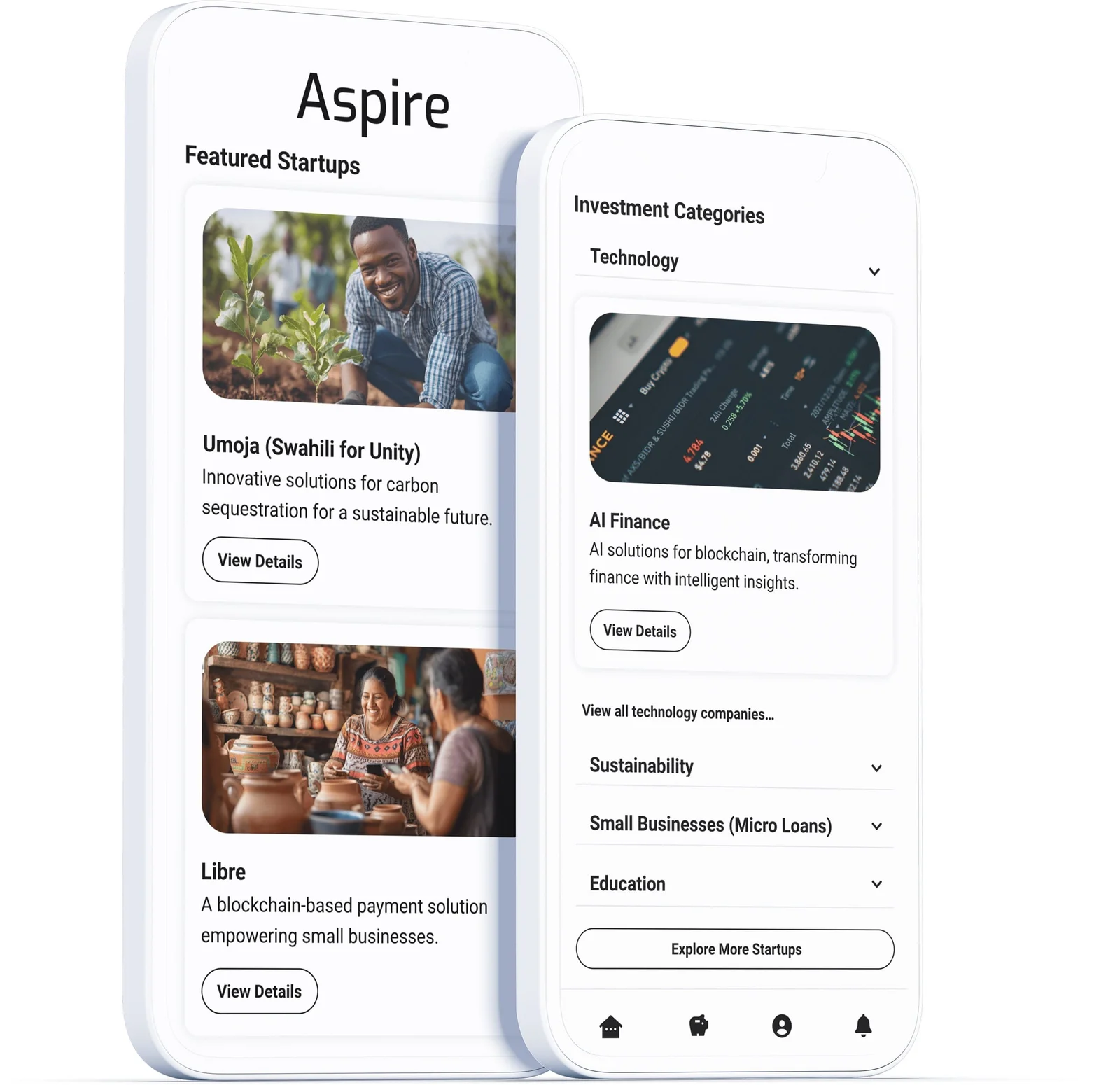
Today's investment ecosystem raises barriers for everyday investors and starves early-stage founders of transparent capital. I designed Aspire around five pillars meant to answer that directly: blockchain-backed security, milestone-based transparency, global access to capital, efficient fund disbursement through smart contracts, and stablecoins to cut cross-border friction.
Research
The real design problem was trust, not the discovery flow. Aspire proposes removing conventional intermediaries from investing, which means the interface itself has to do the trust-building work a bank or a broker usually does. I built three investor personas around that question: a community investor prioritizing local impact, an impact investor prioritizing accountability, and a crypto-savvy investor prioritizing on-chain verification, then mapped each one's journey from first discovery through reinvestment.
- Persona development: three investor archetypes, each defining trust and an acceptable return differently.
- Journey mapping: the decisions, proof points, and feedback loops that move each persona from evaluating a raise to reinvesting.
- Moderated usability testing: four tasks, each scored on a five-point Likert scale, against a written research plan.
- Competitive analysis: benchmarked against institutional funds, peer-to-peer micro-lending, and rewards crowdfunding.

Persona 1: The Community Investor
David and Sarah Mitchell
48 & 45 years old, Boulder, CO
I framed David and Sarah as suburban investors who care about local businesses and community-driven projects, seeking structured, milestone-based investments that provide financial returns while also delivering measurable community impact and business growth.
“I need a platform that's fast, transparent, and lets me stay in control of my investments. If I can track everything in real-time and reinvest seamlessly, that's a game-changer.”
Investment style
Long-term, community-focused: interested in local business growth and economic sustainability over speculative returns.
Preferred startup types
Small businesses, local enterprises, sustainable agriculture, and impact-driven tech that strengthens communities.
Risk tolerance
Moderate: willing to take some risk, prioritizing verified businesses with measurable impact and stability.
Tech proficiency
Intermediate: comfortable with online investing and fintech tools, but prefers user-friendly platforms with clear impact tracking.
Preferred platforms
Uses Honeycomb Credit, Crowdfund Mainstreet, and local investment platforms, but finds them lacking milestone-based transparency.
Financial goal
Build wealth while supporting local businesses and creating lasting community impact with measurable accountability.
How Aspire helps
Blockchain-backed funding ensures funds are allocated based on milestones.
Smart contracts automate payments only when goals are met.
Real-time impact tracking gives visibility into business success and fund utilization.
Hybrid investing model supports community-driven growth with financial security.
Pain points
Lack of structured milestone tracking in local business investing.
Difficult to verify how funds are used post-investment.
Few real-time updates on business progress and impact.
Traditional investments lack community engagement opportunities.
Investment range
$2,500 to $20,000 per year. David and Sarah diversify across multiple local businesses, prioritizing stable, community-focused investments with clear growth potential.
Engagement level
Active: regularly attends local business events, engages with founders, and follows business progress to ensure their investments create meaningful impact.
Investor journeys
Three journey maps, one per persona, tracing proof points from first evaluation to reinvestment.
Community investors: discovery to portfolio growth around milestone-based funding.
Design decisions
I treated trust as an interface problem rather than a legal disclaimer to bury in a footer, since this is a regulated category that earns skepticism by default. Every trust mechanism in Aspire is visible at the moment it matters, not promised in fine print somewhere else.
Finance earns skepticism by default, and crypto doubly so.
Milestones
Staged releases, verifiable in the app
Funding moves in thirds, released on execution, after the first five customers, and at a revenue milestone, with every tranche visible alongside its release reason.
Stablecoins
Explained in plain language
Currency selection states cost, settlement speed, and redeemability up front, with no jargon standing between an investor and the mechanics.
Audits
Updates, not vibes
Founder updates pair a CPA-audit stamp with performance metrics and a downloadable quarterly report, rather than asking an investor to take a founder's word for it.
Disclosures
Where the decision happens
Risk disclosures and FAQs sit inside the funding flow itself, one tap from the amount selector, not buried in a footer.
The funding flow, screen by screen
Six more screens carry the loop from evaluating a raise through tracking the portfolio afterward.
A fictional investment profile: funding goal, raised amount, minimum, term, and illustrative projected return, with risk disclosures one tap away.
Where it stands
I put the concept through moderated, think-aloud usability testing against a written research plan: four tasks on a five-point scale, plus a persona-specific survey, and the results changed both the roadmap and the scope.
Scores
Trust highest, discovery lowest
Testers scored visual design and trustworthiness highest and discovering a new opportunity lowest, out of five.
Roadmap
Discovery, addressed next
An onboarding video, a menu replacing the bottom navigation bar, and a sortable investment history, aimed at the lowest score.
Scope
US-first, not global on day one
A pitch conversation raised cross-border compliance at scale, a risk the persona research had already surfaced, so I scoped the concept to the US first.
What I learned
The lowest score taught me more than the highest one, and research is only doing its job once it changes a decision, not just a screen.
The number
3.5, not defended
Discovery scored 3.5 against everything else in the 4s. I treated that gap as the finding, not something to explain away.
Sequencing
Regulation surfaces before it's a decision
A pitch question, could this survive cross-border compliance, was a risk the persona research had already found but hadn't yet turned into a scope choice.
The lesson
A decision, not just a screen
Research earns its keep when it changes strategy, in this case a deliberate US-first scope, not only which screens get redesigned.